To separate eggs cleanly, chill the eggs in the refrigerator first so the yolk membrane stays firm. Crack each egg against a flat countertop, open the shell over a small bowl, and let the albumen slide through your slightly parted fingers while holding the yolk. Work with three separate bowls so a single broken yolk never ruins an entire batch of whites.
Four reliable ways to separate an egg
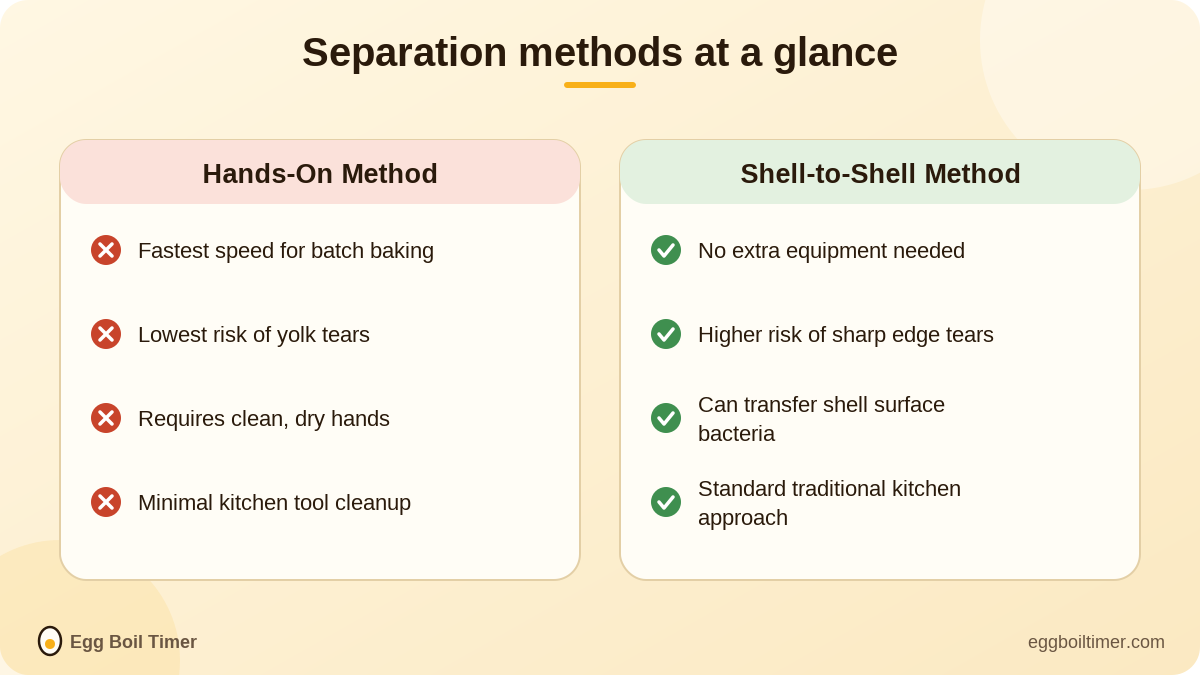
Choosing the right technique depends on your kitchen equipment, batch size, and how comfortable you feel handling raw yolks. While traditional recipes often recommend using eggshell halves, modern culinary practice favors methods that minimize sharp edges and contact with outer shell surfaces.
| Method | Speed | Yolk Rupture Risk | Cleanup Required | Best Suited For |
|---|---|---|---|---|
| Clean Hands | Fast | Very Low | Hand washing only | Baking large batches |
| Shell-to-Shell | Moderate | Moderate | No extra tools | Quick single-egg tasks |
| Plastic Bottle Suction | Fast | Low | Recyclable bottle | Beginners and kids |
| Slotted Separator Tool | Slow to Moderate | Low | Separator gadget | Small precise quantities |
Hands, shells, and bottle suction: exact steps for four methods
Every separation technique relies on isolating the dense outer albumen from the membrane-bound yolk center. Master these four approaches to find the one that fits your workflow.
The clean hands method
Wash your hands thoroughly with warm water and soap, then dry them completely. Crack the chilled egg on a flat surface and open the contents into your cupped fingers over a small bowl. Open your fingers slightly so the white drains through while keeping the yolk rested safely in your palm.
Transfer the clean yolk to a second bowl. This approach offers superior control because skin lacks the sharp edges of cracked shells, reducing puncture risks for delicate batters like a classic How to Make a Soufflé: Ratios, Rise Science, and Recipe.
The traditional shell-to-shell method
Crack the egg firmly around its middle on a flat surface, then pull the upper shell upward over a bowl. Tilt the lower shell to let free white spill into the bowl, then pass the yolk back and forth between shell halves until the albumen separates completely.
Exercise caution with this method. Sharp broken edges can puncture the yolk membrane. Food safety guidelines also warn that sliding raw egg contents over outer shell surfaces increases the risk of transferring bacteria into raw batters.
The plastic bottle suction trick
Crack your egg into a shallow dish. Squeeze an empty plastic water bottle slightly, place its opening gently against the yolk, and slowly release your grip. The vacuum pulls the yolk up into the bottle, leaving the clear white behind.
Squeeze the bottle over a second bowl to deposit the whole yolk. This trick speeds up separation for multiple eggs, though older eggs with weaker membranes can break under strong suction.
Using a commercial slotted separator
Hook a slotted plastic or stainless-steel egg separator over the rim of a small cup or bowl. Crack the egg directly into the center of the tool's cradle. The narrow slots permit the thick liquid white to drop straight through into the cup while retaining the rounded yolk in the central cup. If the thick albumen clings to the top, rock the tool gently from side to side to help it slip through the slots without disturbing the yolk base.

Why cold eggs separate cleaner than warm ones
Temperature dictates the physical structure of raw egg components. The vitelline membrane, which encloses the liquid yolk, contains structural proteins that remain firm and elastic at refrigeration temperatures near 4 °C (39 °F). As an egg warms to room temperature (20 °C or 68 °F), this protective membrane stretches and weakens, making the yolk far more vulnerable to splitting open during handling.
Egg white viscosity changes with temperature as well. Cold albumen stays tightly clustered around the yolk structure, allowing you to slice through or drop the thick white cleanly. Warm whites become thin and watery, running freely across surfaces but dragging bits of yolk along if the membrane ruptures.
Whipped egg foams require strict separation for dishes like stiff Mastering Meringue: French, Swiss, and Italian Techniques structures or delicate Pavlova Recipe: How to Make a Crisp Meringue Base bases. Egg yolk contains roughly 32% fat by weight, along with natural emulsifiers like lecithin. When lipid molecules enter raw whites, they coat hydrophobic areas of proteins like ovalbumin and ovotransferrin.
This oil coating blocks proteins from unfolding and bonding around air pockets, preventing foam expansion or causing whipped peaks to collapse into liquid. If your recipe requires boiled eggs instead of separated whites, use our precise Egg Boil Timer to check exact cooking times by size and altitude.

Removing stray yolk droplets and shell fragments
A single slip can break a yolk or drop a shell piece into your bowl. Acting quickly saves the batch before fat spreads through the whites.
If a fragment of eggshell drops into your bowl of whites, skip fingers and metal spoons, which slide across viscous whites. Instead, scoop it out using half an empty eggshell. The sharp edge slices cleanly through albumen, and the shell's inner membrane naturally attracts and grips the loose fragment.
When a yolk ruptures into your whites, your next move depends on how much fat spilled:
- Single isolated drop: Touch the droplet with an ice cube or a damp paper towel wrapped over your finger. Yolk fat solidifies against the cold surface or clings to wet paper fibers, lifting out without smearing.
- Heavy yolk contamination: Whisking contaminated whites will fail because fat prevents foaming. Instead of throwing them out, transfer the mixture to a container for baking Classic Sponge Cake: The Master Recipe and Aeration Science, binding meatloaves, or making scrambled eggs. Start fresh with a clean, dry bowl.
Storing separated whites and yolks safely
Recipes frequently call for only one part of the egg, leaving extra components behind. Separated whites and yolks spoil faster than whole eggs in the shell because they lack natural barrier protections, making proper refrigeration essential.
According to USDA food safety guidelines, raw separated egg whites and yolks keep in airtight containers at 4 °C (39 °F) or lower for 2 to 4 days. Because exposed yolks dry into a hard crust within hours, place them in a small glass container, cover them with one tablespoon of cold water, and seal the lid. Pour off the water right before whisking the yolks into rich mixtures like Custard Recipe and Science: Perfecting Egg-Thickened Creams.
For long-term storage, freeze egg whites in ice cube trays. Once solid, transfer the cubes to an airtight bag, where they retain their whipping quality for up to 12 months. Yolks require preparation before freezing. Raw yolk proteins form a rubbery gel when frozen plain. To prevent gelation, whisk 4 egg yolks with either a pinch of salt for savory dishes or half a teaspoon of sugar for baking before storing them in airtight containers.


